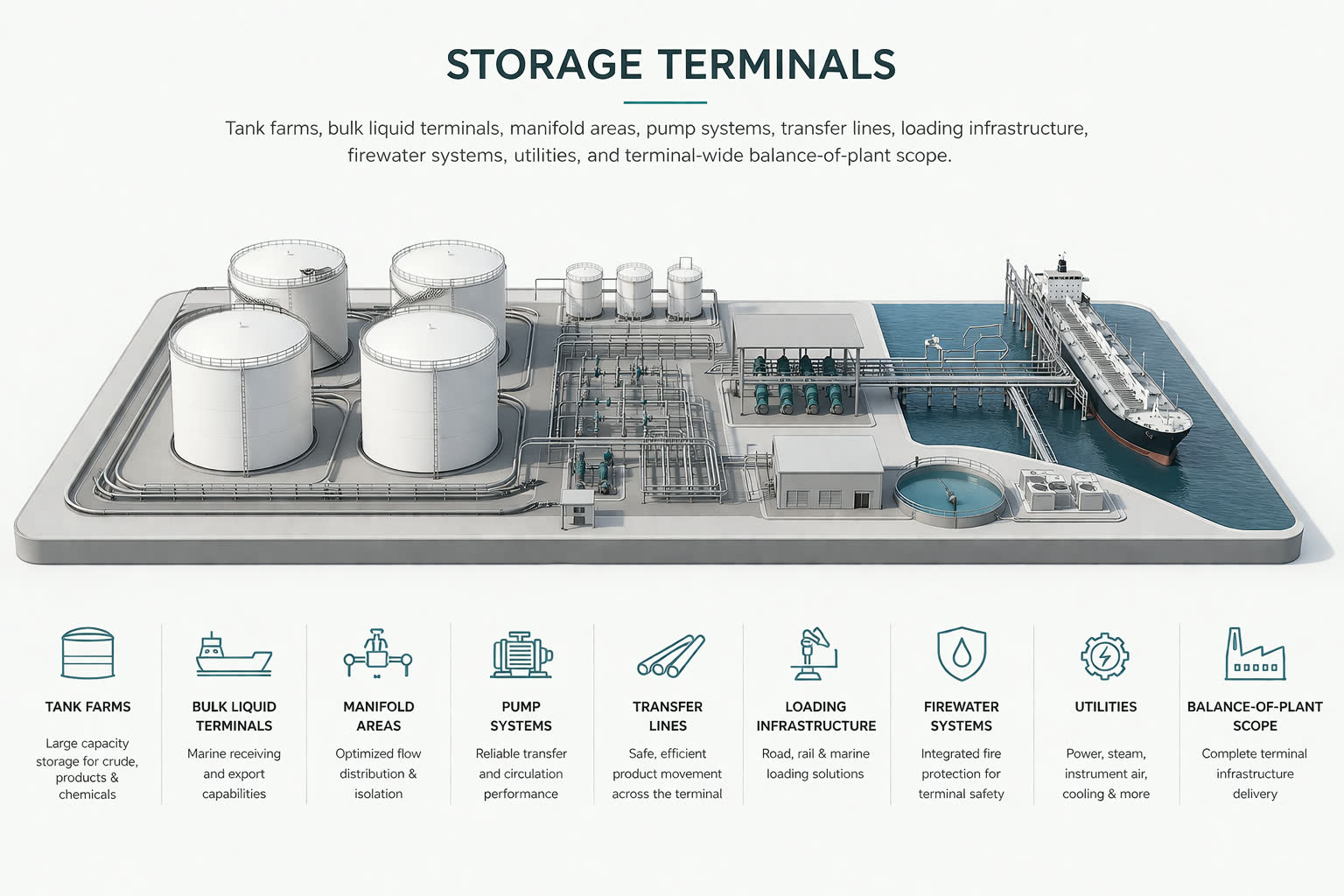
Storage terminals
Tank farms, bulk liquid terminals, manifold areas, pump systems, transfer lines, loading infrastructure, firewater systems, utilities, and terminal-wide balance-of-plant scope.

Core Capabilities
Chemie-Tech combines engineering, procurement, fabrication, construction, commissioning, and operating support to deliver storage terminals, refinery tankage, process infrastructure, and industrial facilities with stronger technical control from design through handover.
Delivery Lifecycle
Chemie-Tech coordinates six core delivery stages according to the contracted scope.
Delivery Platform
Chemie-Tech coordinates project delivery from engineering through handover. Capabilities cover engineering, procurement, fabrication, construction, commissioning and post-handover support according to the contracted scope.
For clients, that means fewer disconnects between design, purchasing, fabrication, field execution, and final turnover. Critical decisions stay closer to the people delivering the work.
This structure supports owners, developers, and prime contractors looking for a delivery partner that can manage engineering definition, procurement quality, fabrication readiness, site execution, and handover preparation as one coordinated responsibility.
Engineering deliverables, procurement packages, fabrication readiness, construction sequencing, and turnover planning are developed with shared visibility rather than as separate silos.
UAE fabrication capacity adds control over weld quality, material traceability, package readiness, inspection hold points, and shop-to-site coordination.
Projects are planned with mechanical completion, testing, turnover documentation, and operational readiness in view, not pushed into the final weeks as close-out tasks.
Sector Relevance
These capabilities are strongest in the sectors where Chemie-Tech has the deepest execution history and delivery experience: storage terminals, refinery tankage, and process-linked industrial infrastructure.
Tank farms, bulk liquid terminals, manifold areas, pump systems, transfer lines, loading infrastructure, firewater systems, utilities, and terminal-wide balance-of-plant scope.
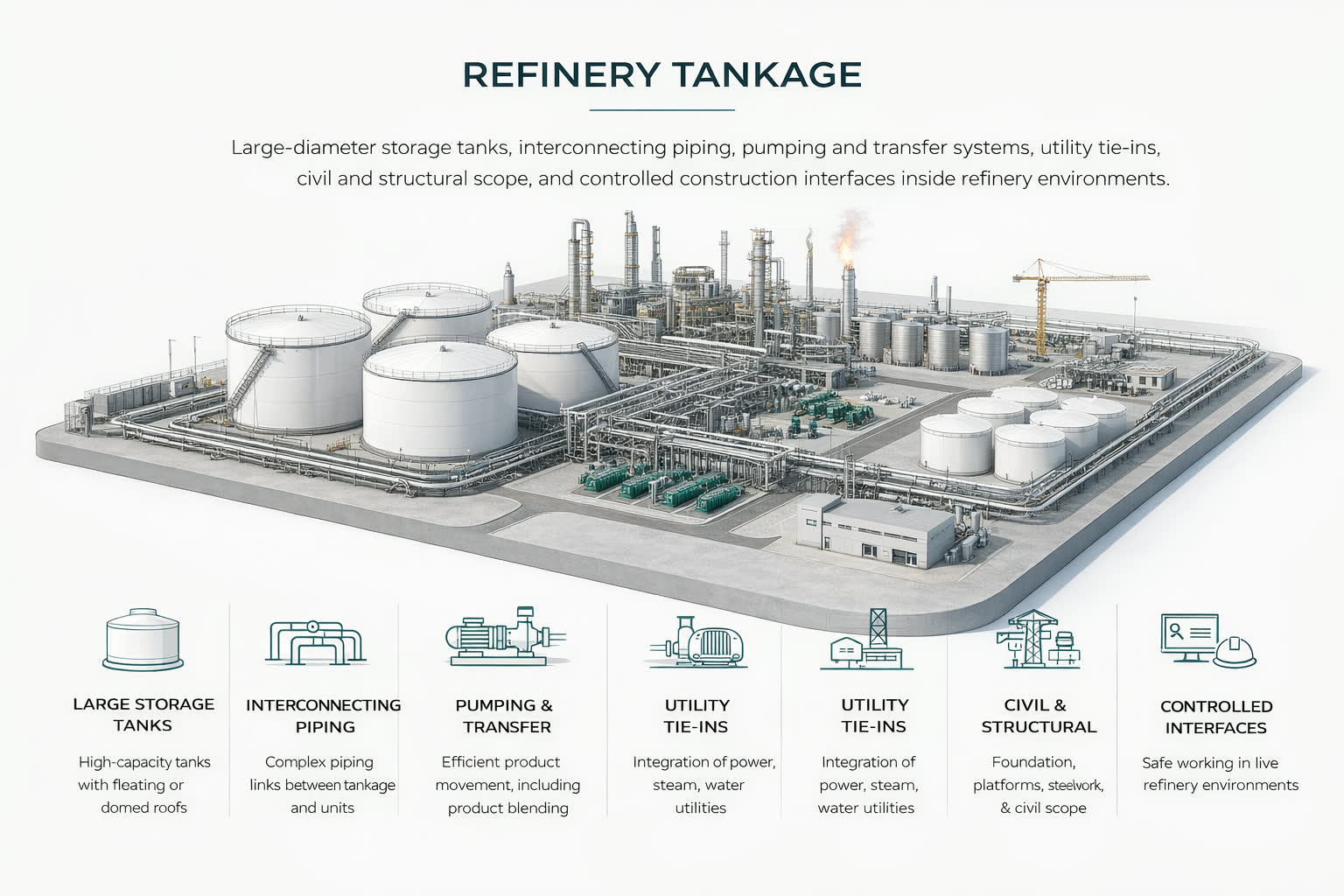
Large-diameter storage tanks, interconnecting piping, pumping and transfer systems, utility tie-ins, civil and structural scope, and controlled construction interfaces inside refinery environments.
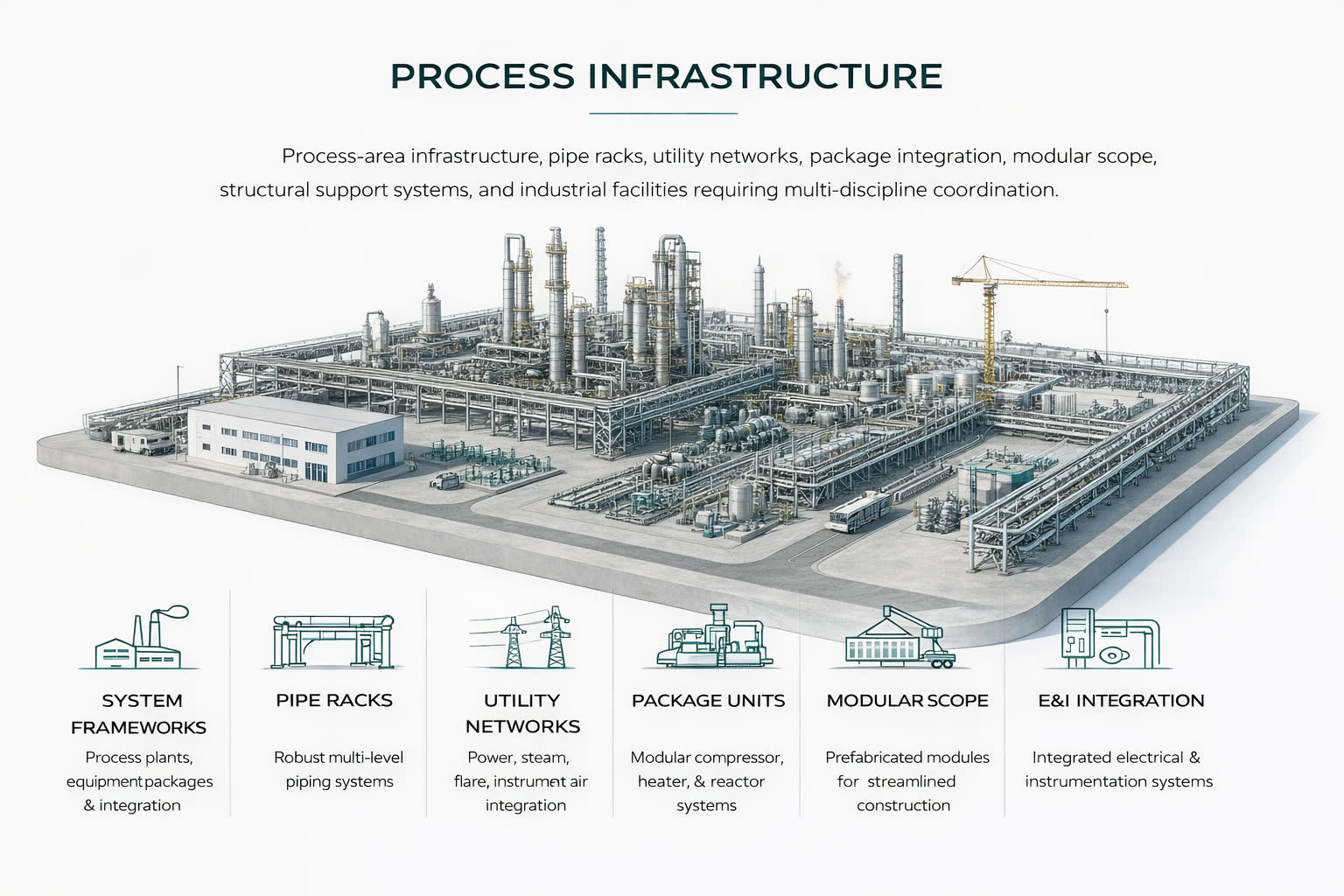
Process-area infrastructure, pipe racks, utility networks, package integration, modular scope, structural support systems, and industrial facilities requiring multi-discipline coordination.
Delivery Disciplines
Each capability carries its own technical depth. The real advantage comes from how these capabilities connect across engineering, fabrication, site execution, and handover.
01 Engineering & Design
Multi-discipline engineering across process, mechanical, piping, civil, structural, electrical, instrumentation, and safety, developed to support buildable, operable, and maintainable outcomes in terminals, tankage, and process facilities.
02 Procurement & Logistics
Procurement support spanning material requisitions, bid evaluation, vendor qualification, inspection coordination, freight planning, and delivery sequencing for mechanical, piping, structural, tankage, and package scope.
03 Fabrication & Modularisation
Two UAE fabrication yards support tank fabrication, pipe spools, structural steel, skids, coatings, testing, and coordinated shop-to-site delivery for storage, refinery, and process-infrastructure scope.
04 Construction & Project Controls
Civil, structural, mechanical, piping, E&I, lifting, permitting, reporting, progress measurement, and change control are managed through one coordinated site execution structure across terminals, tankage, and industrial infrastructure.
05 Commissioning & Handover
Mechanical completion, loop checks, cleaning, pressure testing, control-system verification, performance testing and handover documentation are planned as part of an organised turnover process for tanks, piping systems, utilities and process packages.
06 Operations Support
Operator familiarisation, training, troubleshooting, maintenance setup, spares planning, and reliability support help clients move from completion into stable operations.
Technical Workstreams
These workstreams connect engineering, fabrication, project controls and system turnover across the delivery lifecycle.
Equipment sizing support, tank systems, pump and manifold scope, piping material definition, static equipment interfaces, utility scope, and process-linked mechanical coordination.
Piping layouts, transfer lines, manifolds, isometrics, supports, structural frames, foundations, platforms, underground interfaces, and erection-linked coordination.
Load lists, cable schedules, JB layouts, instrument indexes, loop definitions, control philosophy support, fire-and-gas interfaces, and field verification tied to commissioning needs.
ITPs, weld traceability, NDT coordination, hydrotest support, punch close-out, turnover dossiers, and documentation packages aligned to client acceptance.
Engineering Systems
These engineering, planning, coordination, and quality systems are used across Chemie-Tech projects according to client standards, project scope, and execution requirements.
PDMS / E3D, AutoCAD, AutoCAD Plant 3D, SmartPlant 3D, CADWorx, MicroStation, InTools, CAESAR II, PV Elite, STAAD.Pro, STAAD Foundation, AFT Fathom, AFT Arrow, HTRI, Aspen HYSYS, and Aspen Plus.
Primavera P6 and Microsoft Project for schedule development, progress tracking, and planning control.
SharePoint and WRENCH for document control, transmittals, data management, and execution records.
Navisworks for 3D coordination, model review, and clash-detection support during design and execution planning.
In-house weld tracking and NDE systems supporting traceability, inspection status visibility, and quality-record control.
Tool selection varies by client standards, project complexity, sector requirements, and the specific engineering or execution package being delivered.
Execution Model
The value of the platform is not just capability depth in individual functions. It is the way engineering, procurement, fabrication, construction, and turnover are connected into one controlled delivery sequence.
Front-end definition, layouts, material take-offs, and design coordination establish the technical basis for procurement, fabrication, and site execution before work reaches the field.
Vendor qualification, long-lead planning, inspection follow-up, and documentation flow are aligned to actual fabrication windows and installation priorities, not handled as a detached buying cycle.
Tank components, pipe spools, structures, and package supports can be prepared in controlled yard conditions with stronger traceability, inspection control, and shipment sequencing before installation starts.
Site execution is supported by look-ahead planning, reporting, cost control, interface coordination, and change management so progress remains visible and decisions remain timely.
Mechanical completion, punch closure, testing, dossiers, and system-based handover planning are advanced early so the final phase moves as a controlled transition into operations.
Where required, Chemie-Tech supports start-up, operator familiarisation, maintenance readiness, and early operating performance after construction and handover are complete.
Fabrication Proof
These fabrication assets strengthen quality control, schedule reliability, traceability, and shop-to-site readiness across tankage, piping, structural, and package-support work.
Primary fabrication base supporting higher-volume tankage, structures, pipe fabrication, and controlled shop testing for large storage and refinery-linked scope.
Secondary fabrication base supporting structural work, pipe spools, coatings, and flexible throughput for selected industrial and process packages.
Controlled fabrication environments improve traceability from raw material receipt through cutting, welding, inspection, coating, and dispatch.
Shop-based work allows hold points, witness points, dimensional control, and NDT coordination to be managed with greater consistency than field-heavy execution alone.
Packages can be prepared, marked, released, and shipped in a sequence that supports erection logic and reduces disruption once work reaches site.
Capability Proof
Capabilities matter when they translate into execution confidence, stronger delivery control, and cleaner project interfaces.
ISO 9001, ISO 14001, ISO 45001, API Q1, and API 650 Monogram-backed systems reinforce quality discipline, documentation rigour, and fabrication credibility.
Chemie-Tech has delivered across multiple regions and demanding operating environments where schedule discipline, interface control, and field governance are critical.
Projects are planned with testing, turnover, and operating readiness in view rather than leaving those requirements to the final weeks of execution.
Drawings, vendor data, inspection records, test packs, and turnover dossiers are treated as execution-critical deliverables, not only final paperwork.
The delivery structure is designed to reduce gaps between engineering, procurement, fabrication yards, vendors, subcontractors, and site execution teams.
Execution is anchored in recognised codes, documented procedures, inspection planning, and acceptance criteria that support technically credible delivery.
Standards & Codes
Discuss Delivery Capability
For technical prequalification, capability review, or project-specific delivery planning, connect directly with the Chemie-Tech team.